
A reliable freight forwarder China to USA can help you manage more than ocean freight costs. Rising US trucking rates can also affect port pickups, interstate transportation, warehouse transfers, and final delivery to Amazon FBA fulfillment centers. For Chinese manufacturers, exporters, and cross-border e-commerce sellers, these domestic transportation costs can influence landed costs and delivery schedules even after cargo reaches the United States.
On November 10, 2026, DAT Freight & Analytics reported that the average US dry van spot rate reached $3.05 per mile in October, its highest monthly average since February 2022. The rate increased by $0.98 year over year. Meanwhile, the planned 16-month closure of California’s Vincent Thomas Bridge adds uncertainty to truck movements around the Los Angeles–Long Beach port complex. These developments make route planning, warehouse coordination, and carrier availability important considerations when arranging China to USA shipping. (Sources: DAT and Maersk.)
How Rising US Trucking Rates Affect Freight Forwarding
Interstate trucking: Longer routes can increase delivery costs
Interstate trucking connects US ports, distribution centers, regional warehouses, and FBA fulfillment centers. When spot rates rise, shipments moving from Los Angeles to Chicago, Dallas, or East Coast destinations may face higher transportation costs.
DAT reported an October national average dry van spot rate of $3.05 per mile, including fuel. Of this amount, the estimated linehaul component was $2.22 per mile, according to DAT. This figure represents DAT’s estimated linehaul portion of the spot rate, not an actual route-specific quote received by a customer. Both figures are national averages and estimates rather than guaranteed shipping prices. Actual charges depend on the route, equipment, shipment requirements, and carrier availability.
Note: DAT’s national dry van spot rate is a truckload market benchmark, not a direct quotation for port drayage or container transportation. Actual trucking costs vary by route, equipment, cargo type, and service requirements.
If your cargo enters through a West Coast port but needs delivery to the Midwest or East Coast, compare the total cost of inland trucking with alternative port gateways and intermodal options before booking.
Local delivery: Receiving conditions affect the final bill
Local trucking covers deliveries from overseas warehouses to FBA centers, third-party logistics (3PL) facilities, commercial premises, and residential addresses.
Your actual cost may depend on:
- Delivery appointments and receiving windows.
- Waiting time at warehouses or fulfillment centers.
- Liftgate requirements and oversized cargo.
- Residential delivery or limited unloading access.
- Additional stops and regional distribution distances.
For example, a shipment requiring liftgate service at a residential address may need different equipment and pricing from palletized cargo delivered to a commercial warehouse with a loading dock.
Port drayage: Los Angeles–Long Beach requires additional planning
Port drayage moves shipping containers between marine terminals, container yards, and warehouses. Its cost and timing depend on terminal appointments, chassis availability, container return requirements, and local traffic.
According to Maersk’s November 4, 2026 advisory, the Vincent Thomas Bridge closure began on November 7 and is expected to continue for approximately 16 months, with reopening targeted for early March 2028. Approximately 8% of drayage traffic in the port complex uses the bridge. Rerouting may increase travel times and make appointment planning less predictable.
If your shipment arrives through Los Angeles or Long Beach, confirm terminal availability, truck routes, warehouse receiving hours, and empty-container return arrangements before dispatch.
Which Transportation Option Fits Your Shipment?
Different shipment profiles call for different arrangements. Compare the main options before selecting your freight forwarding and domestic delivery plan.
| Transportation option | Best suited for | Main consideration |
|---|---|---|
| Full truckload (FTL) | Large, consolidated shipments | Route rates and truck availability |
| Less-than-truckload (LTL) | Smaller palletized shipments | Minimum charges and handling |
| Port drayage | Containers moving from terminals to warehouses | Appointments, chassis, and empty returns |
| Overseas warehouse distribution | Multiple orders or delivery destinations | Storage, handling, and last-mile charges |
| Intermodal transportation | Suitable long-distance inland routes | Rail schedules and transfer requirements |
No single option is always the cheapest. Compare the complete shipment cost, including port handling, inland transportation, transfers, warehouse services, and destination delivery.
How to Reduce US Trucking Costs and Delivery Risks
Use the following steps to improve transportation planning:
- Confirm your delivery requirements. Provide the destination ZIP code, shipment dimensions, weight, pallet count, delivery deadline, and unloading conditions.
- Compare complete route costs. Evaluate West Coast entry with inland trucking against alternative gateways or intermodal options where appropriate.
- Secure capacity early. For recurring shipments, discuss planned volumes and regular lanes with your freight forwarder instead of relying entirely on last-minute spot bookings.
- Coordinate warehouse appointments. Confirm receiving windows, unloading equipment, container free time, and empty-return instructions before dispatch.
- Monitor shipment milestones. Track port release, container pickup, warehouse arrival, dispatch, and proof of delivery so your team can respond to delays promptly.
These steps help you identify avoidable charges and coordinate international shipping with US domestic transportation.
How NIUKU Logistics Supports China to USA Freight Forwarding
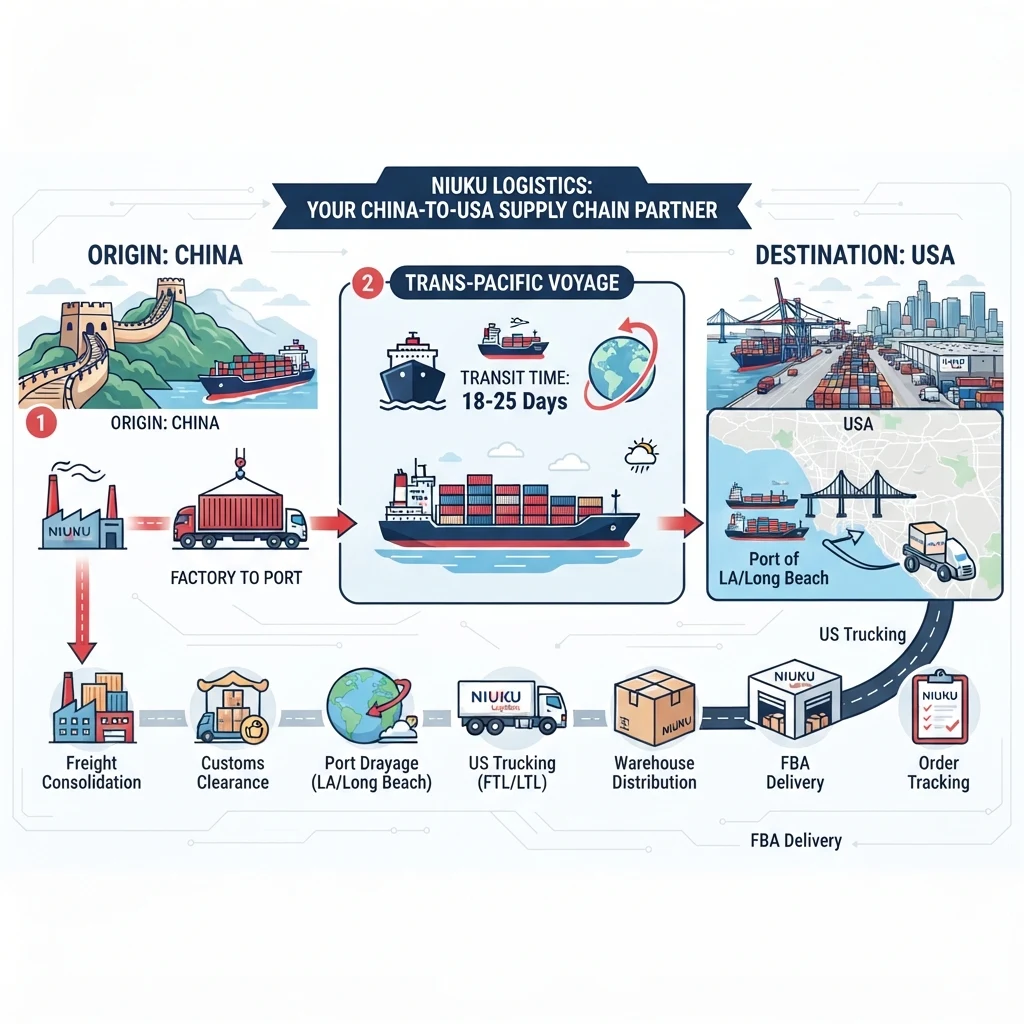
NIUKU Logistics provides cross-border transportation and fulfillment services for e-commerce sellers, manufacturers, and exporters shipping to the United States and other international markets.
Its service network combines international freight, overseas warehousing, container pickup and delivery, deconsolidation, and domestic distribution. The company reports operating 20 overseas warehouses with more than 2.2 million square feet of space, alongside 25 domestic warehouse locations in China.
For US domestic transportation, NIUKU reports a fleet of more than 150 self-operated trucks and a distribution network covering the contiguous 48 states, supported by additional transportation partners. These resources support different shipping scenarios, including:
- Port-to-warehouse container transportation.
- Interstate freight movements and FBA replenishment.
- Container deconsolidation and regional distribution.
- Commercial and residential delivery.
- Warehouse fulfillment for multiple orders and destinations.
NIUKU also reports working with major e-commerce logistics programs and platforms, including Amazon SEND, FIST Elite, SPN, TikTok Shop, Wayfair, Walmart, and TEMU. Its in-house warehouse management system (WMS) and transportation management system (TMS) support inventory and shipment milestone tracking.
Service availability, transit times, and charges depend on the specific route and shipment requirements. Ask for a route-specific quotation and confirm the applicable service scope before booking.
FAQ
1. Why are US trucking rates affecting China to USA shipping costs?
Trucking connects ports with warehouses and final destinations. Higher spot rates, limited carrier availability on certain lanes, and local congestion can increase inland transportation costs even when ocean freight rates remain unchanged.
2. How can I reduce trucking costs for Amazon FBA shipments?
Consolidate shipments where practical, compare destination routes, book transportation in advance, and confirm FBA appointments and unloading requirements. A freight forwarder that coordinates port drayage, warehousing, and final delivery can help you evaluate the full logistics cost.
3. What should I confirm before booking a freight forwarder China to USA?
Confirm the origin and destination, cargo dimensions and weight, shipping method, customs clearance scope, estimated transit time, delivery requirements, included charges, and potential accessorial fees. Also clarify shipment tracking, exception handling, and proof-of-delivery procedures.
Conclusion
Choosing the right freight forwarder China to USA means evaluating the entire transportation chain, not just the ocean freight quotation. Rising US trucking rates, port access changes, and warehouse receiving requirements can all affect your delivery budget and schedule. By comparing routes, securing suitable capacity, and coordinating port drayage with domestic distribution, you can make better-informed shipping decisions.
If you are planning shipments from China to US ports, warehouses, or Amazon FBA fulfillment centers, contact NIUKU Logistics to discuss your cargo details, destination, delivery deadline, and preferred shipping method. Request a tailored transportation plan and itemized quotation to compare available routing and fulfillment options.