For cross-border e-commerce exporters in China, logistics, customs filing and tax compliance are closely connected with customs filing, tax compliance, and supply-chain documentation. For cross-border e-commerce sellers, missing purchase invoices can create uncertainty when goods leave China for overseas markets. However, China’s tax framework provides a specific “no-invoice tax exemption” policy for eligible cross-border e-commerce retail exports in comprehensive pilot zones. Under the current framework, you need to understand the eligibility requirements, customs process, data registration, and supporting documents before choosing a logistics model.
What Is the No-Invoice Tax Exemption?
The “no-invoice tax exemption” policy refers to a VAT and consumption tax exemption available to eligible cross-border e-commerce export enterprises that cannot obtain valid purchase documentation for exported goods.
The core policy is Caishui [2018] No. 103, jointly issued by the Ministry of Finance, State Taxation Administration, Ministry of Commerce, and General Administration of Customs. The policy took effect on October 1, 2018.
The policy can be relevant when you purchase products from suppliers that cannot provide valid input invoices. Instead of treating the absence of an invoice as an automatic barrier to export tax exemption, you first need to verify whether your business and export transaction meet the prescribed conditions.
Key Conditions for Eligibility
According to the policy, the following conditions apply:
- Your e-commerce export enterprise must be registered in a Cross-Border E-Commerce Comprehensive Pilot Zone.
- You must register export information through the local cross-border e-commerce online comprehensive service platform.
- The registration needs to include information such as export date, product name, unit, quantity, unit price, and amount.
- The goods must complete the required e-commerce export declaration through the customs authority in the relevant pilot zone.
- The exported goods must not fall into categories for which the relevant authorities have cancelled export tax refund or exemption treatment.
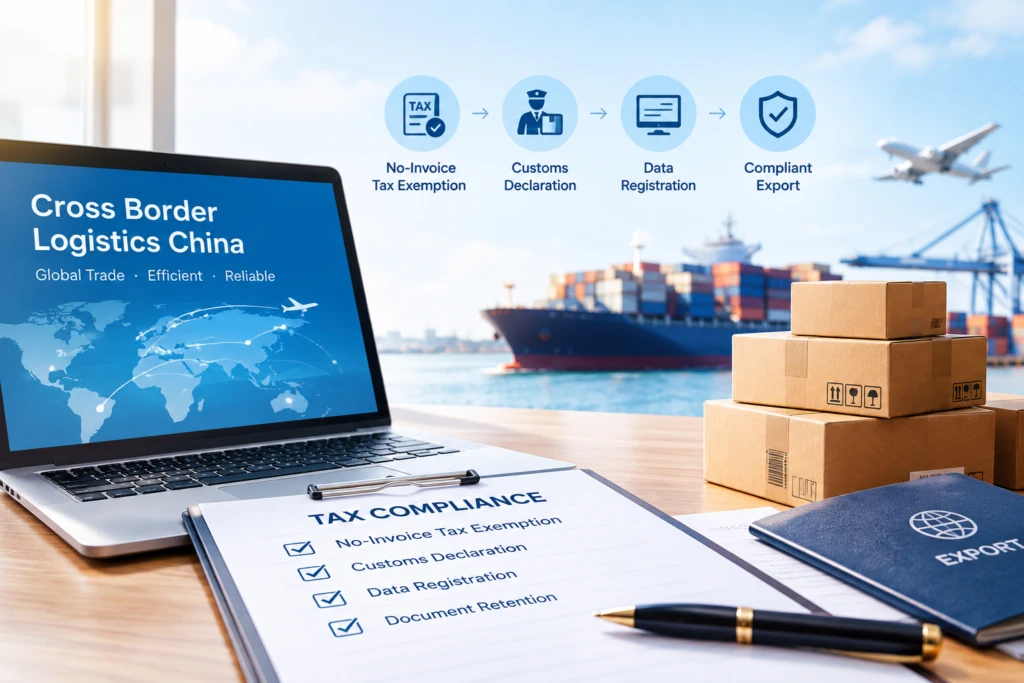
Therefore, “no invoice” does not mean “no compliance requirements.” Customs, tax, platform, and logistics data still need to form a consistent transaction chain.
How Does Cross Border Logistics China Support Compliance?
When you select a cross border e-commerce logistics China provider, logistics should not be viewed only as transportation from a Chinese warehouse to an overseas warehouse.
A practical logistics process can involve:
- Domestic collection and warehousing
Goods are collected from manufacturing clusters and consolidated before export. - Order and shipment data management
Product information, quantities, shipment details, and logistics records should be properly maintained. - Customs declaration
Your export model determines the appropriate customs process. For eligible retail export transactions, 9610 is the specific customs supervision code associated with the policy in relevant tax guidance. - International transportation
Depending on cargo characteristics and delivery requirements, you can select sea freight, air freight, or other cross-border transportation solutions. - Destination delivery
The shipment can continue through overseas warehouses, FBA warehouses, commercial addresses, or residential addresses according to the selected service. - Document retention
Keep contracts, payment records, logistics documents, customs information, and other evidence that can demonstrate the authenticity of the transaction.
No-Invoice Tax Exemption vs. Export Tax Refund
Understanding the difference helps you avoid using the wrong tax terminology.
| Item | No-Invoice Tax Exemption | Export Tax Refund |
|---|---|---|
| Main purpose | Exemption from applicable export VAT/consumption tax | Refund/exemption under applicable export tax rules |
| Purchase invoice | Specific eligible transactions may lack valid purchase documentation | Generally requires compliance with applicable documentation requirements |
| Typical policy context | Eligible cross-border e-commerce retail exports in comprehensive pilot zones | Applicable export goods and enterprises under relevant tax rules |
| Key requirement | Pilot-zone registration, platform information, customs declaration and other conditions | Export tax refund/exemption registration and supporting documents |
| Logistics role | Supports compliant customs and transaction documentation | Supports export declaration and document chain |
Importantly, tax exemption and logistics service are separate concepts. A freight forwarder cannot independently determine whether your enterprise qualifies for a tax policy.
Why Documentation Matters for China Cross Border Shipping
For businesses using China to USA logistics, FBA logistics China, or other international delivery services, documentation should remain consistent throughout the shipment.
For example, suppose you purchase consumer goods from multiple small suppliers, consolidate them at a domestic warehouse, and then ship them to an overseas fulfillment location. You should maintain a traceable record covering:
- Supplier and purchasing information
- Payment records
- Product and quantity information
- Customs declaration information
- Freight and warehouse records
- Overseas delivery records
- Platform transaction information
This documentation helps demonstrate the authenticity and consistency of the export transaction when relevant authorities conduct verification.
The State Taxation Administration has also issued separate rules concerning enterprise income tax for qualifying cross-border e-commerce retail export enterprises in comprehensive pilot zones. Therefore, VAT exemption should not be interpreted as meaning that all tax obligations disappear.
How NIUKU Supports Cross-Border E-Commerce Logistics
NIUKU International Logistics provides cross-border logistics services covering the United States, Canada, Europe, and Mexico.
According to the company’s supplied business information, NIUKU operates 25 domestic warehouses, 19 overseas warehouses, and a logistics network covering major Chinese industrial regions and overseas destinations. The company reports more than 80,000 m² of domestic warehouse space, more than 2,200,000 sq ft of overseas warehouse space, 150+ self-operated trucks, and service for more than 30,000 cross-border enterprises.
Its service portfolio includes:
- FBA ocean and air freight
- Door-to-door cross-border logistics
- FCL and LCL shipping
- Overseas warehousing
- One-piece fulfillment
- Customs clearance and delivery
- Cross-border project logistics
- International express services
NIUKU also states that it holds or works with logistics qualifications and platform programs including Amazon SEND Carrier, FIST Elite Carrier, SPN Service Provider, TikTok Shop, Wayfair 3PL, Walmart Solution Provider, and TEMU logistics programs.
These company-specific credentials should be verified against the latest official platform or regulatory records before being used as independent third-party claims.
FAQ
Can I export goods without a purchase invoice?
Potentially, but the absence of an invoice alone does not create tax exemption. You must first determine whether your enterprise, export transaction, registration, customs declaration, and goods meet the applicable policy conditions.
Does 9610 automatically mean tax exemption?
No. 9610 is a customs supervision code for cross-border e-commerce retail exports, while tax exemption depends on satisfying the applicable tax-policy conditions. Local tax guidance explicitly connects the relevant no-invoice exemption framework with 9610 retail exports.
Can a freight forwarder guarantee my tax exemption?
No. A logistics provider can support customs declaration, transportation, warehousing, and documentation, but your enterprise’s tax treatment depends on the applicable laws, regulations, registration status, transaction structure, and local tax administration.
Conclusion
For businesses evaluating Cross Border Logistics China, transportation cost is only one part of the decision. A compliant export process also requires appropriate customs procedures, accurate data registration, traceable logistics records, and coordination between your business, logistics provider, customs, and tax authorities. By understanding the specific requirements of the no-invoice tax exemption policy and selecting a logistics partner with domestic warehousing, overseas fulfillment, customs experience, and cross-border delivery capabilities, you can build a more transparent export workflow. NIUKU provides cross-border logistics services across the US, Canada, Europe, and Mexico, supporting different transportation and fulfillment scenarios for cross-border e-commerce businesses.
CAT
Before arranging your next shipment, review your export destination, sales model, customs supervision code, purchase documentation, and delivery requirements. Then contact NIUKU International Logistics to discuss the appropriate China-to-overseas shipping, FBA, warehousing, and door-to-door logistics solution for your business.