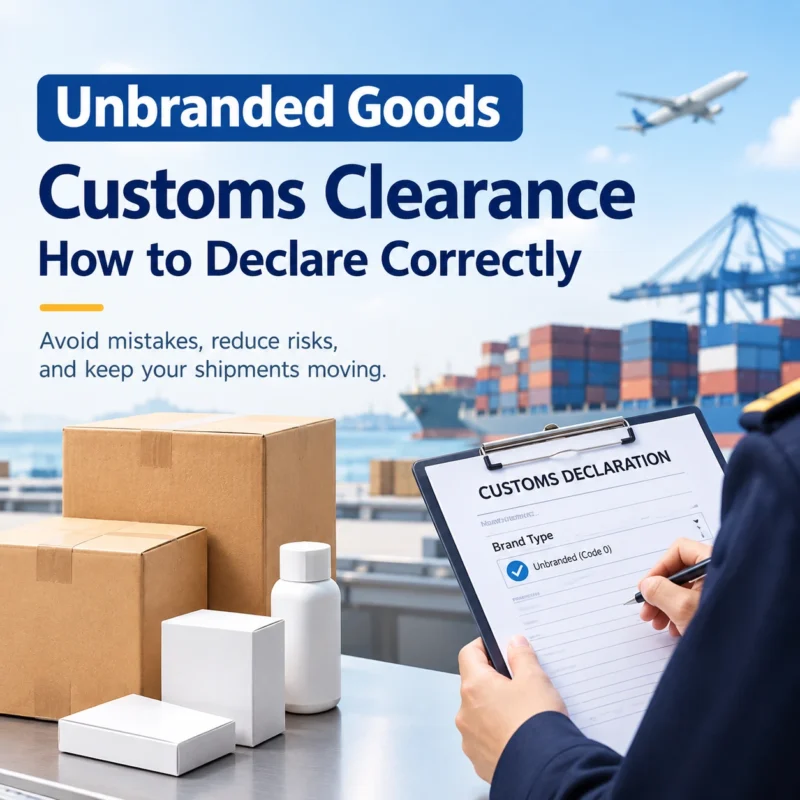
When you export unbranded products from China, NIUKU Customs Clearance can help you avoid one of the most overlooked compliance problems: declaring the wrong brand information. Many exporters ask whether they should enter “N/A,” leave the field blank, or select “unbranded” on the customs declaration. The answer depends on the actual condition of the goods and their packaging. China Customs requires the brand type to be declared truthfully, and “unbranded” is one of the recognized declaration categories.
For cross-border sellers, getting this detail wrong can create additional document checks, declaration corrections, or delays. Therefore, you should verify the product, packaging, documents, and destination-country requirements before shipment.
What Does “Unbranded” Mean in Customs Declaration?
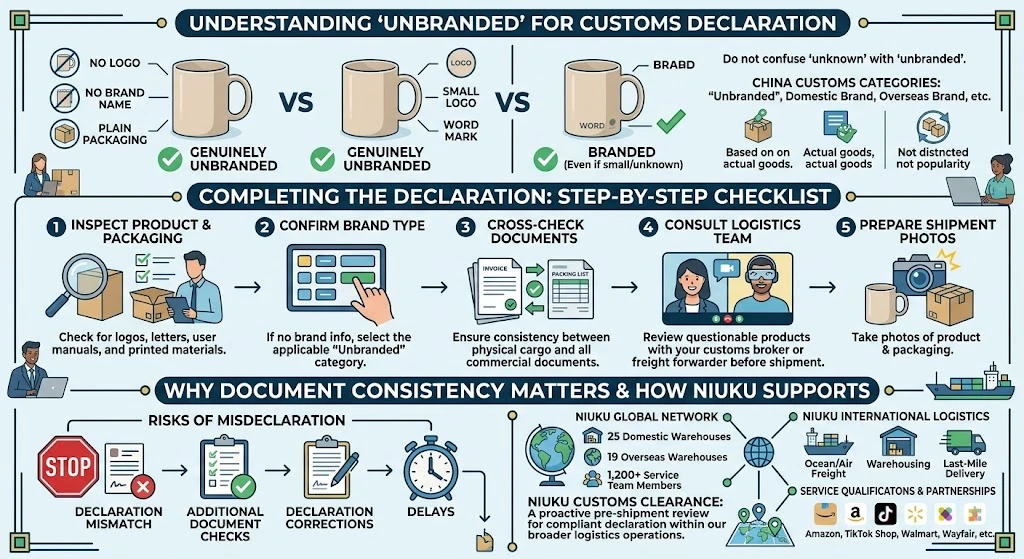
The first step in NIUKU Customs Clearance is to distinguish a genuinely unbranded product from a low-profile or unknown brand.
A product is not automatically “unbranded” simply because it does not have a famous brand. You should check whether the product and its packaging carry brand information, including:
- Brand names or word marks
- Logos or graphic identifiers
- Letters or combinations used as brand identifiers
- Product labels and hangtags
- Inner and outer packaging
- User manuals and printed materials
China Customs identifies “brand type” as a required declaration item and provides several categories, including “unbranded,” domestic own brand, acquired domestic brand, and different types of overseas brands. The declaration should correspond to the actual brand status of the goods.
Unbranded vs. Unknown Brand
| Situation | Brand Type | Customs Declaration Approach |
|---|---|---|
| No brand identifier on product or packaging | Unbranded | Select the applicable “Unbranded” category |
| Small or unfamiliar brand | Branded | Declare the actual brand information |
| OEM product using a foreign brand | Overseas brand | Declare according to the applicable brand category |
| Product has a visible logo or word mark | Branded | Do not treat it as unbranded |
This distinction matters because customs declaration is based on the actual goods rather than the popularity of the brand.
How to Complete an Unbranded Goods Customs Declaration
For unbranded goods customs clearance, you should focus on consistency between the physical cargo and declaration documents.
China Customs’ published declaration guidance states that brand type is a required field and should be declared truthfully. The “unbranded” category is specifically intended for goods without brand information.
Step-by-Step Customs Declaration Checklist
- Inspect the physical product
Check the product surface for logos, letters, labels, or other potential brand identifiers. - Inspect all packaging
Review inner packaging, cartons, labels, hangtags, manuals, and other printed materials. - Confirm the brand category
If the goods genuinely have no brand information, select the applicable unbranded category rather than entering an invented brand name. - Cross-check commercial documents
Make sure the commercial invoice, packing list, product description, HS code, quantity, and value are consistent. - Review before cargo departure
Ask your customs broker or freight forwarder to review questionable products before shipment instead of correcting the declaration after an inspection.
Common Customs Declaration Errors and Their Risks
The most common mistake occurs when an exporter treats an unfamiliar brand as an unbranded product.
For example, imagine that you are exporting kitchen accessories. The product looks generic, but a small logo appears on the product body and the same mark appears on the packaging. Declaring the cargo as unbranded creates a mismatch between the physical goods and the declaration.
You should also distinguish brand information from country-of-origin marking. A product can be unbranded while still being subject to applicable origin-marking requirements in the destination market. Customs clearance in China and import compliance in the destination country are separate compliance steps.
Why Document Consistency Matters
Your customs declaration should align with the supporting commercial documents and the physical cargo. If the declared product information does not accurately reflect the shipment, the shipment may require additional review or correction.
For this reason, exporters should review:
- Product name and specification
- Brand information
- HS classification
- Quantity and weight
- Declared value
- Country of origin
- Invoice and packing list information
- Destination-country import requirements
How NIUKU Supports Compliant Export Customs Clearance
For cross-border sellers, customs declaration is only one part of the international logistics process. NIUKU Customs Clearance works within NIUKU’s broader China-to-overseas logistics network, helping customers coordinate cargo preparation, documentation, customs procedures, and subsequent transportation.
NIUKU International Logistics operates a network covering China, the United States, Canada, the United Kingdom, Europe, and Mexico. The company reports 25 domestic warehouses, 19 overseas warehouses, more than 80,000 m² of domestic warehouse space, over 2,200,000 ft² of overseas warehouse space, and 1,200+ service team members.
NIUKU also holds logistics service qualifications and partnerships covering Amazon SEND, FIST Elite, SPN, TikTok Shop, Wayfair 3PL, Walmart, and TEMU. Its NVOCC/FMC qualification and self-operated logistics resources support its broader cross-border transportation and fulfillment operations.
For exporters handling regular shipments, this integrated model can connect customs preparation with ocean freight, air freight, overseas warehousing, and last-mile delivery instead of treating customs as an isolated step.
FAQ
1. Can I declare a product as unbranded if the brand is not famous?
Not necessarily. Brand popularity does not determine whether goods are unbranded. You should inspect the product and its packaging and declare the actual brand status.
2. Should I leave the brand field blank for an unbranded product?
You should not simply leave a required brand-type field blank. China Customs’ published guidance identifies brand type as a required declaration item and provides “unbranded” as a specific category.
3. Does successful export customs clearance mean the shipment is fully compliant?
No. Export declaration and destination-country import compliance are different processes. You should also check applicable origin-marking, product, labeling, and import requirements before shipping.
Conclusion
Correct documentation is the foundation of reliable cross-border logistics. By checking the physical product, packaging, brand information, commercial documents, and destination requirements before shipment, you can reduce avoidable customs declaration problems. With NIUKU Customs Clearance, NIUKU International Logistics provides customs-related support as part of a broader cross-border logistics network, helping exporters coordinate compliant declaration with transportation and overseas fulfillment.
CTA
Before your next shipment, prepare the product photos, packaging photos, commercial invoice, packing list, HS code, and destination country. Share these details with NIUKU professional logistics team for a pre-shipment review and clarify potential customs declaration issues before the cargo leaves China.