China to Canada customs clearance can become complicated when product information, HS classification, origin, value or supporting documents do not match the actual shipment. Even a small inconsistency can trigger questions, additional processing, delays or unexpected duties and taxes.
Commercial shipments also involve two regulatory sides. China export requirements may include inspection, quarantine, certificates or product-specific documentation, while Canadian import clearance focuses on tariff classification, origin, value for duty, permits, taxes and import accounting. Planning both sides before pickup creates a more predictable shipping process.
What Does China to Canada Customs Clearance Involve?
A commercial shipment normally requires a set of documents and data that support both export compliance in China and import compliance in Canada.
- Commercial invoice
- Packing list
- Bill of lading, air waybill or other transport document
- Detailed product description and specifications
- HS / tariff classification
- Country of origin information
- Certificates, licences or permits when required
- Technical documents for regulated products
- Importer information and customs broker details
On the Canadian side, the importer is responsible for properly accounting for imported commercial goods. The importer should determine the applicable tariff classification, country of origin, value for duty, duties and taxes, and any other government department requirements before importation.
China Export Inspection and Canadian Import Clearance Are Different
China Export Side
Depending on the commodity and current rules, goods exported from China may require inspection, quarantine, certificates, special packaging or other supporting documents. Exporters should confirm the product’s HS code and actual regulatory requirements instead of assuming that every shipment follows the same inspection process.
- Product category and HS code
- Manufacturing or sourcing location
- Product specifications
- Packaging and labelling
- Required certificates
- Consistency between declarations and supporting documents
Canada Import Side
Commercial importers generally need the appropriate Canadian business registration and access to the CBSA Assessment and Revenue Management (CARM) system. Where a licensed customs broker is used, the importer can authorize the broker to act on its behalf through the applicable CARM process. The importer remains responsible for the accuracy and compliance of the import declaration.
China to Canada Customs Clearance: Key Requirements Compared
| Item | China Export Side | Canada Import Side |
| Product information | Accurate description and specifications | Detailed information for tariff classification and admissibility |
| HS code | Used for export declaration and regulatory checks | Canadian tariff classification determines import treatment |
| Origin | Manufacturing/source information should be accurate | Country of origin may affect tariff treatment and marking |
| Documents | Invoice, packing list and applicable certificates | Invoice, origin records, permits and accounting documents |
| Regulatory checks | May include inspection or quarantine | CBSA and other Canadian agencies may apply controls |
| Duties / taxes | Depends on China export procedures | Assessed under Canadian import rules |
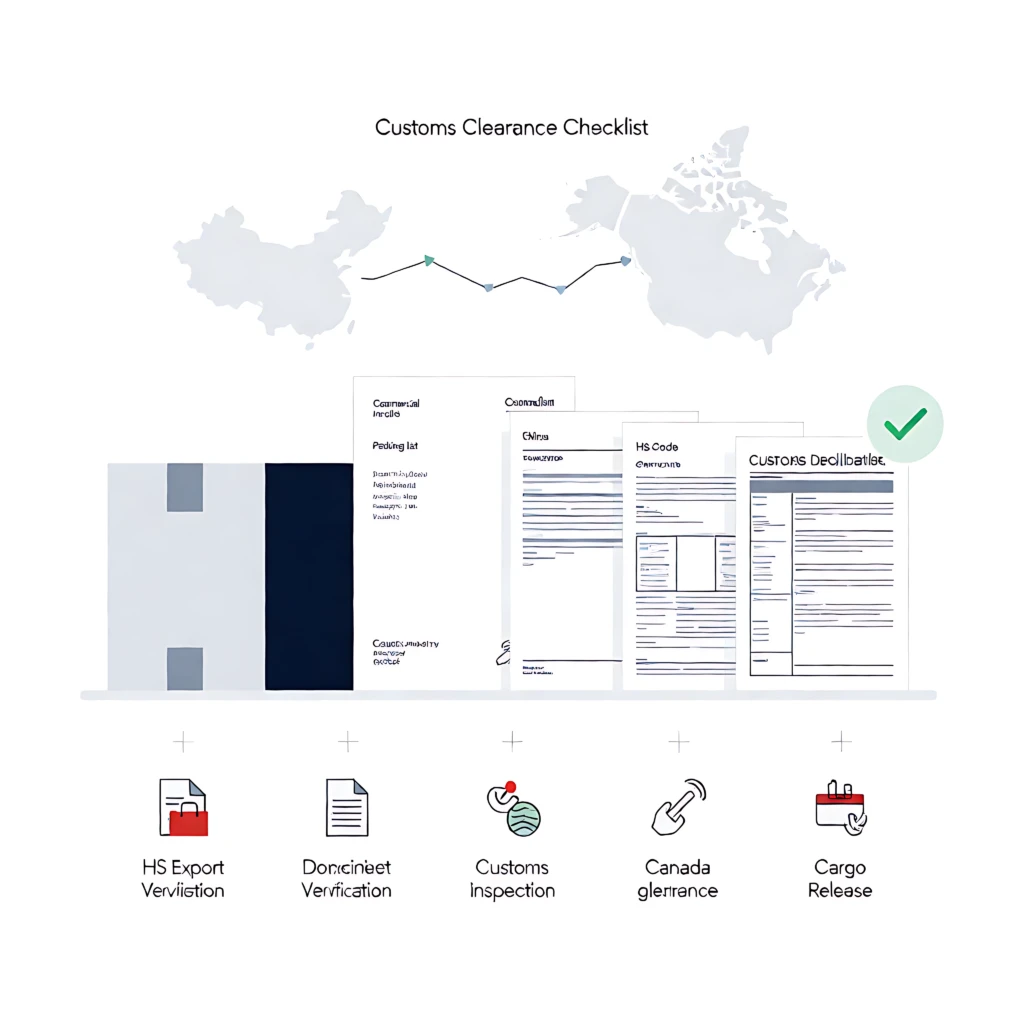
5 Steps for China to Canada Customs Clearance
1. Confirm the Product and HS Code
Start with an accurate product description that identifies the material, function, model, intended use and country of origin. Then determine the appropriate HS or Canadian tariff classification. Do not copy a code from a previous shipment unless it truly matches the current product.
2. Check China Export Requirements
Before pickup, verify whether the goods require inspection, quarantine, certificates, special packaging, testing or other export documentation. Regulated products should be reviewed before the shipment reaches the port or airport.
3. Prepare Consistent Shipping Documents
The commercial invoice, packing list, transport documents, declaration information, product description, quantity, value and origin should remain consistent. This is particularly important for consolidated cargo and shipments containing multiple SKUs.
4. Prepare Canadian Import Clearance
Confirm the importer information, CARM arrangements, customs broker authorization if applicable, expected duties and taxes, and any product-specific permits or other government requirements before arrival.
5. Complete Release and Keep Post-Clearance Records
After arrival, the required import declaration, release and accounting procedures must be completed under the applicable process. Importers should also retain invoices, packing lists, transport documents and other supporting records for the required retention period.
How NIUKU Supports China-to-Canada Shipping
For businesses that need more than port-to-port freight, NIUKU coordinates China pickup, domestic warehousing, ocean or air transportation, customs clearance coordination, overseas warehousing and final delivery. According to the company information supplied for this article, the network includes 25 domestic warehouses and collection points, 19 overseas warehouses, 2.2 million+ sq. ft. of overseas warehouse capacity, 80,000+ m² of domestic warehouse capacity, 150+ self-operated trucks and a professional team of more than 1,200 people.
The practical advantage is the ability to coordinate multiple logistics stages as one workflow instead of treating export pickup, international transportation, customs and final delivery as disconnected tasks.
FAQ
What documents are needed for China to Canada customs clearance?
Typical commercial shipments use a commercial invoice, packing list, transport document, detailed product information, origin information and any required permits or certificates. Exact requirements depend on the commodity and import circumstances.
Does every shipment from China to Canada require export inspection?
No. China export requirements depend on the commodity, HS classification and applicable regulations. Product-specific requirements should be checked before shipment.
Can a customs broker handle Canadian customs clearance?
Yes. A licensed customs broker can perform authorized customs-related activities on behalf of the importer. The importer remains responsible for ensuring that the goods are properly accounted for and compliant.
Conclusion
Reliable China-to-Canada customs clearance begins before the goods leave China. Confirming the HS classification, origin, product requirements, export documents, Canadian import requirements and CARM arrangements in advance can reduce avoidable delays and create a more predictable shipping process.Before booking a China-to-Canada shipment, send NIUKU the product name, HS code if available, cargo type, quantity, origin, destination and preferred shipping method. The logistics team can review the shipment workflow and coordinate the relevant transport and clearance steps.